


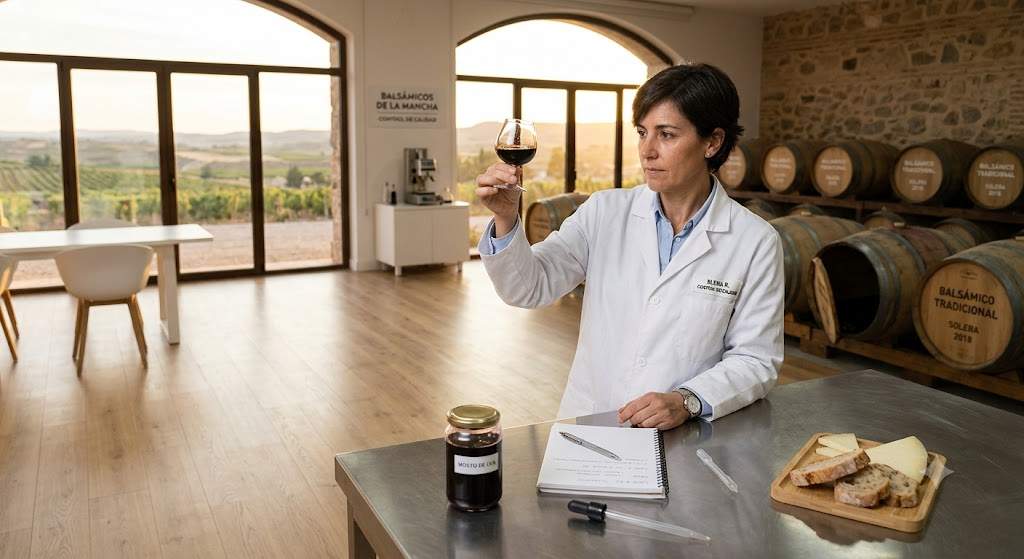
Balsamic Vinegar Production Process | Tradition, Quality and Applications

Balsamic vinegar is one of the most highly valued products in the food industry and gastronomy thanks to its balance of sweetness, acidity and aromatic complexity. However, behind its distinctive organoleptic characteristics lies a carefully controlled production process that directly influences its quality and its culinary and industrial applications.
Understanding what balsamic vinegar is and how it is produced helps to identify the differences between the various types available on the market and choose the most suitable option for each application.
At Goyval Vinagres, we understand how important the production process is in achieving a consistent, safe product adapted to the requirements of the food industry. For this reason, our balsamic vinegars combine carefully selected raw materials, technical expertise and strict control throughout the production process.
What Is Balsamic Vinegar and How Is It Produced?
Balsamic vinegar is a condiment made by combining vinegar with grape-derived ingredients, usually concentrated or cooked grape must. Its composition, the proportion of ingredients, the production process and any maturation period may vary depending on the type of balsamic vinegar and the specifications of each product.
In the case of Goyval balsamic vinegars, the formulation is based on wine vinegar and concentrated grape must. The addition of grape must contributes sweetness, colour, body and greater aromatic complexity, creating the characteristic balance between sweet and acidic notes.
When looking at balsamic vinegar and how it is produced, it is important to understand that the quality of the finished product depends both on the raw materials used and on the controls applied throughout every stage of production.
Balsamic Vinegar Production Process Step by Step
Although the process may vary depending on the type of product and each manufacturer’s specifications, balsamic vinegar production usually follows several key stages.
Selection of Raw Materials
Everything begins with the careful selection of raw materials, as their quality directly affects the aroma, colour and balance between sweetness and acidity in the finished product.
At Goyval, we select the wines used to produce our wine vinegar, as well as the concentrated grape must and the other ingredients included in each formulation.
Our location in Castilla-La Mancha, the region with the largest vineyard area in the world, gives us access to a wide variety of locally sourced wines and allows us to select those best suited to the desired profile for each product. This proximity to the raw material is an important advantage in maintaining a reliable supply and consistent characteristics.
Acetic Fermentation of the Wine
The wine used as a raw material has already undergone alcoholic fermentation, during which the natural sugars in the grapes are converted into alcohol by yeasts.
At the vinegar factory, acetic fermentation then takes place. During this stage, acetic acid bacteria convert the alcohol present in the wine into acetic acid, which is responsible for vinegar’s characteristic acidity.
Careful monitoring of this process is essential to obtain a stable wine vinegar with the appropriate parameters for its subsequent use in the balsamic formulation.
Formulation, Blending and Homogenisation
Once the wine vinegar has been produced, it is combined with concentrated grape must and the other ingredients included in each product formulation.
The proportion of vinegar to grape must directly influences the acidity, sweetness, aroma, colour and body of the balsamic vinegar. This stage therefore requires precise dosing and correct homogenisation to ensure consistent characteristics from batch to batch.
Maturation and Ageing, Where Applicable
One of the most representative stages of certain balsamic vinegars is the maturation or ageing period.
During this time, the ingredients become more integrated and the product may develop greater aromatic complexity, softer acidity and a more rounded profile.
Not all balsamic vinegars undergo the same process or are matured for the same length of time. Depending on the category, formulation and characteristics required, maturation may be relatively short or may extend over months or years in aged products.
Maturation or ageing is not part of the production process for every product. Goyval’s white balsamic vinegar, for example, is not barrel-aged, as the aim is to preserve its light colour and characteristic profile.
What Determines the Quality of Balsamic Vinegar?
Not all balsamic vinegars offer the same characteristics. Final quality depends on several factors throughout production, including:
- Quality of the wines and concentrated grape must used.
- Balance between grape must and wine vinegar.
- Control of acetic fermentation.
- Precision during formulation and homogenisation.
- Maturation time and conditions, where applicable.
- Stability of physicochemical parameters.
- Quality controls carried out during production.
For specialised manufacturers such as Goyval, these factors form part of a continuous monitoring process that helps us provide consistent products adapted to each customer’s requirements.
Types of Balsamic Vinegars and Balsamic Creams
Balsamic vinegars can have very different characteristics depending on the raw materials used, the proportion of wine vinegar and grape must, the formulation and any maturation period.
At Goyval, we have developed a range designed for different channels, applications and market positions:
- Darro Balsamic Vinegar. A mid-range product aimed mainly at the HORECA sector, offering a balanced profile and a competitive quality-price ratio compared with other market alternatives.
- Yuca’s Premium Balsamic Vinegar. Our highest-quality conventional balsamic vinegar, with a more complex and balanced profile aimed at gastronomy and the gourmet market.
- Yuca’s Premium Organic Balsamic Vinegar. Made with certified organic raw materials and designed for consumers, distributors and projects looking for a higher-value organic alternative.
- Yuca’s Fig Balsamic Vinegar. A premium speciality combining the sweet-and-sour balance of balsamic vinegar with the distinctive notes of fig. This product was awarded the VINAVIN Grand Gold in 2026.
- Yuca’s White Balsamic Vinegar. Light in colour with a smooth, balanced profile. It is particularly suitable for sauces, dressings and applications where the flavour of balsamic vinegar is desired without darkening the finished product.
In addition to our liquid balsamic vinegars, at Goyval we also produce balsamic cream using our premium Yuca’s balsamic vinegar.
Its thicker texture and smooth, balanced sweetness make it especially suitable for decorating and finishing dishes, salads, meats, cheeses and other gastronomic preparations.
Our range is completed by Aceto Balsamico di Modena PGI, available both as a liquid vinegar and as a cream.
As this is a Protected Geographical Indication, these products are produced in Italy in accordance with the relevant product specification and are marketed by Goyval, but are not manufactured at our facilities.
This enables us to offer everything from a competitive solution for the HORECA sector to premium and organic balsamic vinegars, gourmet specialities, balsamic creams and PGI products, adapting to the needs of each customer and market.
How Is Balsamic Vinegar Different from Other Vinegars?
Although all vinegars contain acetic acid as a characteristic component, balsamic vinegar stands out because of the addition of concentrated grape must and the balance between sweetness and acidity created by its formulation.
These characteristics provide:
- Greater aromatic richness.
- A more balanced flavour.
- Greater density and body than many other vinegars, mainly due to the addition of concentrated grape must.
- A colour that varies according to the type of balsamic vinegar, from the light tones of white balsamic vinegar to the characteristic dark colour of traditional balsamic vinegar.
- Great culinary versatility.
Both traditional balsamic vinegar and white balsamic vinegar contain concentrated grape must. In the case of white balsamic vinegar, the raw materials and formulation are selected to maintain a lighter colour, making it particularly suitable for preparations where the finished product should not be darkened.
Different formulations also make it possible to adapt the balsamic profile to different applications, from competitive HORECA solutions to premium, organic and gourmet products.
These qualities help explain the growing presence of balsamic vinegar both in gastronomy and in the food industry.
Applications of Balsamic Vinegar in the Food Industry
Balsamic vinegar is used far beyond the domestic kitchen. Today, it is found in numerous industrial food applications, including:
- Sauces and dressings.
- Vegetable preserves.
- Ready meals.
- Marinades.
- Gourmet products.
- Gastronomic specialities.
- Balsamic creams for decorating and finishing dishes.
Its stability, consistency and ability to adapt to different formulations make balsamic vinegar a valuable ingredient for food manufacturers and distributors.
Its balance of sweetness and acidity, together with its fuller body, means that it can be used either as a main ingredient in a formulation or to add aromatic nuances and improve the overall profile of the finished product.
For this reason, at Goyval we study the needs of each customer to offer the most suitable product according to the application, channel and market positioning required, from competitive HORECA solutions to premium and organic balsamic vinegars and gourmet specialities.
Frequently Asked Questions About Balsamic Vinegar
What Is the Difference Between Balsamic Vinegar and Balsamic Vinegar of Modena?
The term balsamic vinegar includes different products made from wine vinegar and grape must, whereas Aceto Balsamico di Modena PGI is a protected designation that must comply with specific production requirements established under European regulations.
It can only be produced within its defined geographical area of origin and in accordance with its official product specification.
It is therefore a specific type of balsamic vinegar, but not all balsamic vinegars are Balsamic Vinegar of Modena.
At Goyval, we produce our own range of balsamic vinegars and also offer Aceto Balsamico di Modena PGI in our catalogue, available both as a liquid vinegar and as a cream.
How Long Does the Balsamic Vinegar Production Process Take?
For conventional balsamic vinegars, the process includes the production of wine vinegar, formulation with concentrated grape must, homogenisation and the corresponding quality controls.
Not all balsamic vinegars require prolonged ageing or are barrel-aged. This process is reserved for certain aged products, where maturation helps develop greater aromatic complexity and a more rounded profile.
Other products, such as Goyval’s white balsamic vinegar, are produced through formulation, homogenisation and quality control without barrel ageing in order to preserve their light colour and characteristic organoleptic properties.
What Applications Does Balsamic Vinegar Have in the Food Industry?
Balsamic vinegar is used in a wide variety of products, including sauces, dressings, marinades, preserves, ready meals and gourmet specialities.
Thanks to its balance between sweetness and acidity, it adds value from both an organoleptic and technological point of view, while also offering greater density and body than many other types of vinegar due to the addition of concentrated grape must.
Different formulations make it possible to choose the most suitable product for the final application, from competitive HORECA options to premium, organic and white balsamic vinegars and gourmet specialities.
Balsamic creams, meanwhile, have a thicker texture and are mainly used to accompany, decorate or provide the finishing touch to salads, meats, cheeses and other gastronomic preparations.
Goyval | Quality and Experience in Balsamic Vinegars
Understanding what balsamic vinegar is and how it is produced helps to appreciate the work behind a product that is widely used in both gastronomy and the food industry.
At Goyval, we combine experience, technical expertise and a privileged location in Castilla-La Mancha, the world’s largest wine-growing region, with strict quality controls to produce a wide range of balsamic vinegars for different professional applications.
Our range includes Darro balsamic vinegar, a mid-range option aimed mainly at the HORECA sector; Yuca’s premium balsamic vinegar in both conventional and organic versions; white balsamic vinegar; and specialities such as Yuca’s Fig Balsamic Vinegar, awarded the VINAVIN Grand Gold in 2026.
We also produce balsamic cream using our premium Yuca’s balsamic vinegar. In addition, our catalogue includes Aceto Balsamico di Modena PGI, available both as a liquid vinegar and as a cream.
Our commitment to innovation, continuous improvement and customer satisfaction allows us to provide products that meet the quality and food safety specifications established for each reference.
If you would like to find out more about our range of balsamic vinegars and creams, explore our solutions for distribution, food service, the food industry and gourmet products, or contact our team to discuss your project.