
'/%3E%3C/svg%3E)
'/%3E%3Cpath%20fill='%23b2b2b2'%20d='M241%20382q0%2016%2017%2026%2017%2011%2042%2011t42-11q16-11%2017-26V269H241'/%3E%3Cpath%20fill='%239f7e00'%20d='M241%20379q0%2014%208%2023%209%209%2021%209%2014%200%2021-9%209-9%209-23V269h-59'/%3E%3Cpath%20d='M241%20339v-70h59v110q0%2014-9%2023l-6%205v-68h-15v72q-8%200-14-4v-68zm59%2040c0%2022%2015%2032%2029%2032%2021%200%2030-18%2030-32v-40h-59'/%3E%3Cpath%20fill='%239f7e00'%20d='M266%20277v5h2v12h-3v-5h2v-5h-9v5h2v5h-4v9h3v18h-5v10h34v-10h-5v-18h3v-9h-4v-5h2v-5h-9v5h2v5h-3v-12h2v-5zm42%20101q0%2010%206%2017%206%206%2015%207%2010-1%2016-7%206-7%206-17v-29h-43'/%3E%3Ccircle%20fill='%230044ad'%20cx='329.5'%20cy='372'%20r='6'/%3E%3Cellipse%20fill='%230044ad'%20cx='300'%20cy='340'%20rx='16'%20ry='21'/%3E%3C/svg%3E)

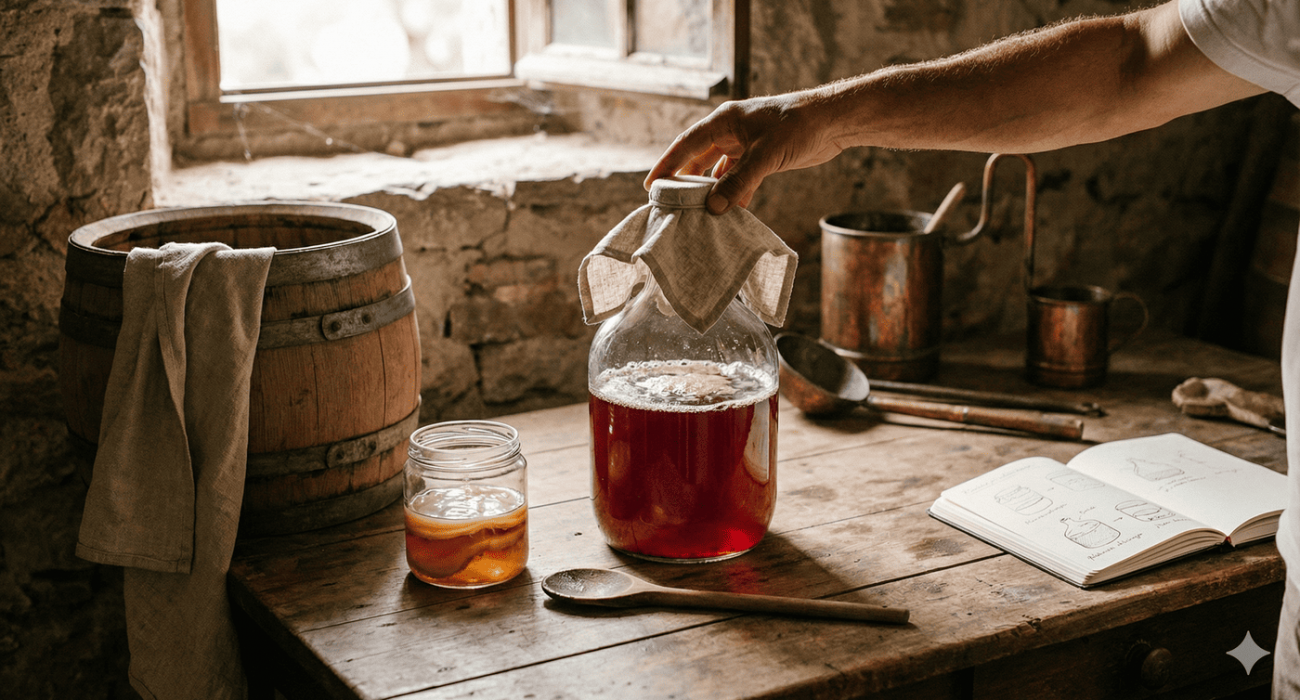
Wine Vinegar Production Process | Stages, Methods and Key Aspects

Wine vinegar has been part of gastronomy for centuries. Its production requires a thorough understanding of the manufacturing process, from wine selection to acetic fermentation and the controls needed to obtain a stable and consistent product.
In professional and industrial applications, understanding how wine vinegar is produced is particularly important, as factors such as the raw material, acidity, batch-to-batch consistency and production system directly influence its performance in different food applications.
In this article, we look at the main stages of the wine vinegar production process, the different production methods and the factors that determine the quality of the finished product.
What Is the Wine Vinegar Production Process?
To understand how wine vinegar is produced, it is important to distinguish between two related biological processes:
- Alcoholic fermentation. This takes place earlier, during wine production, when yeasts convert the sugars in the grapes into alcohol.
- Acetic fermentation. This is the stage specific to vinegar production. Acetic acid bacteria convert the alcohol present in the wine into acetic acid in the presence of oxygen.
Therefore, when the wine arrives at the vinegar factory, it has already undergone alcoholic fermentation. It is during acetic fermentation that the transformation into vinegar takes place.
If you would like to learn more about this process, you can read our article on the acetic fermentation and industrial production process.
Different methods can be used for acetification, ranging from traditional systems to modern submerged culture processes designed to achieve more efficient, controlled and consistent production.
Characteristics and Applications of Wine Vinegar
Wine vinegar stands out for its aromatic profile, acidity and the character it brings to different food preparations.
Depending on the wine used and the production process, different profiles can be obtained for a wide range of gastronomic and professional applications.
Some of its most common uses include:
- Salads and vinaigrettes.
- Sauces and dressings.
- Marinades.
- Pickles.
- Preserves.
- Escabeche preparations.
- Ready meals.
- Gourmet products.
In addition to providing acidity, wine vinegar can contribute to flavour balance and to the characteristics of different food formulations.
For professional applications, you can also read our article on vinegar for sauces, marinades and preserves.
How Is Wine Vinegar Made? Main Stages
Wine vinegar production requires careful attention to factors such as wine quality, fermentation conditions and process control.
At Goyval Vinagres, located in Castilla-La Mancha, one of the world’s major wine-growing regions, we have access to a wide variety of locally sourced wines, allowing us to select the most suitable raw material for each product.
The main stages are:
- Wine selection. The wine is selected according to factors such as alcohol content, colour, aromatic profile and the characteristics required for the finished product.
- Acetic fermentation. The wine enters the fermentation system, where acetic acid bacteria convert the alcohol into acetic acid in the presence of oxygen.
- Control of process conditions. Parameters such as temperature, oxygenation, alcohol concentration and the development of acidity are monitored throughout the process.
- Fermentation monitoring. The product is monitored until it reaches the characteristics established for each reference.
- Quality control. Once the vinegar has been produced, the relevant physicochemical and organoleptic parameters are checked before moving on to the next stages of production.
In industrial production, this level of control is particularly important to ensure consistent quality, stability and batch-to-batch uniformity.
You can learn more about how vinegar quality is controlled during production in our article on processes, analysis and traceability.
Are There Different Methods for Producing Wine Vinegar?
Yes. Different production systems can be used depending on the type of product, production volume and desired characteristics.
The best-known methods include traditional acetification systems and submerged culture, which is widely used in industrial production.
In submerged culture, the acetic acid bacteria remain within the liquid and receive a controlled supply of oxygen. This allows the process to operate efficiently while providing greater control over production conditions.
In every case, raw material quality and fermentation control are essential to achieve a stable and consistent product.
Wine Vinegar Production Methods
The main systems include:
- Traditional acetification methods. The transformation takes place more slowly through contact between the product and oxygen.
- Controlled fermentation systems. These allow the main process variables to be monitored and provide more consistent results.
- Submerged culture. Particularly suitable for industrial production due to its efficiency and capacity to handle larger volumes.
At Goyval Vinagres, we work with continuous controlled fermentation systems, allowing us to maintain consistent quality and adapt production to our customers’ requirements.
What Role Does Barrel Ageing Play in Wine Vinegar?
The use of barrels should be distinguished from the acetic fermentation process itself.
Certain vinegars may subsequently undergo a period of maturation or ageing in wood, during which their aromatic and sensory characteristics evolve.
This process can provide greater complexity and a more rounded profile, depending on the type of vinegar and the length of ageing.
However, not all wine vinegars are barrel-aged. Ageing is reserved for products where this specific profile is desired.
Wine Vinegar for the Food Industry
In addition to its gastronomic use, wine vinegar is a widely used raw material in the food industry for the production of sauces, marinades, preserves, pickles, escabeche products, ready meals and other formulations.
In these applications, flavour is not the only important factor. Manufacturers need a product that maintains stable acidity, consistent batch-to-batch characteristics and reliable technical specifications.
Depending on the application, different types of wine vinegar can be used:
- White wine vinegar, versatile and suitable for a wide range of formulations.
- Red wine vinegar, with a more intense profile and greater character.
- Decolourised wine vinegar, particularly useful when the characteristics of wine vinegar are required without significantly affecting the colour of the finished product.
- Aged wine vinegar, intended for products where a more complex and distinctive profile is required.
- Organic wine vinegar, for projects requiring certified organic production.
We can also work with different acidity levels depending on the application and the technical requirements of each customer.
If you would like to explore some of its industrial applications, you can read our article on vinegar for sauces, marinades and preserves.
At Goyval, we supply wine vinegar both in retail formats and in bulk for manufacturers, distributors and importers, adapting the product and logistics solution to the requirements of each project.
Can Wine Vinegar Be Made at Home?
Acetic fermentation can also be carried out on a small scale at home, although the domestic process is very different from professional manufacturing.
In industrial production, it is essential to work with controlled parameters, analysis, traceability and defined specifications, particularly when vinegar is intended for food manufacturers and continuous production processes.
What Factors Influence the Quality of Wine Vinegar?
The quality of the finished product depends on several factors, including:
- Quality and characteristics of the wine used.
- Correct development of acetic fermentation.
- Temperature and oxygenation control.
- Final acidity.
- Batch-to-batch stability.
- Physicochemical and organoleptic controls.
- Traceability throughout the process.
Keeping these parameters under control makes it possible to obtain consistent vinegars adapted to different applications, both gastronomic and industrial.
Goyval Vinagres | Experience in Wine Vinegar Production
Understanding the wine vinegar production process helps to appreciate the work behind a product widely used in both gastronomy and the food industry.
At Goyval Vinagres, we have been producing vinegar since 1996, combining experience, carefully selected raw materials and controlled fermentation processes to manufacture different types of wine vinegar.
Our range includes white, red, decolourised and aged wine vinegar, as well as organic options and different acidity levels depending on the application and customer requirements.
For industrial projects, we also supply bulk vinegar in IBCs, tankers, flexitanks and ISO tanks, adapting the supply solution to the volume and destination of each project.
If you need a wine vinegar adapted to a specific application, contact our team and we will assess the most suitable characteristics and supply format for your project.