


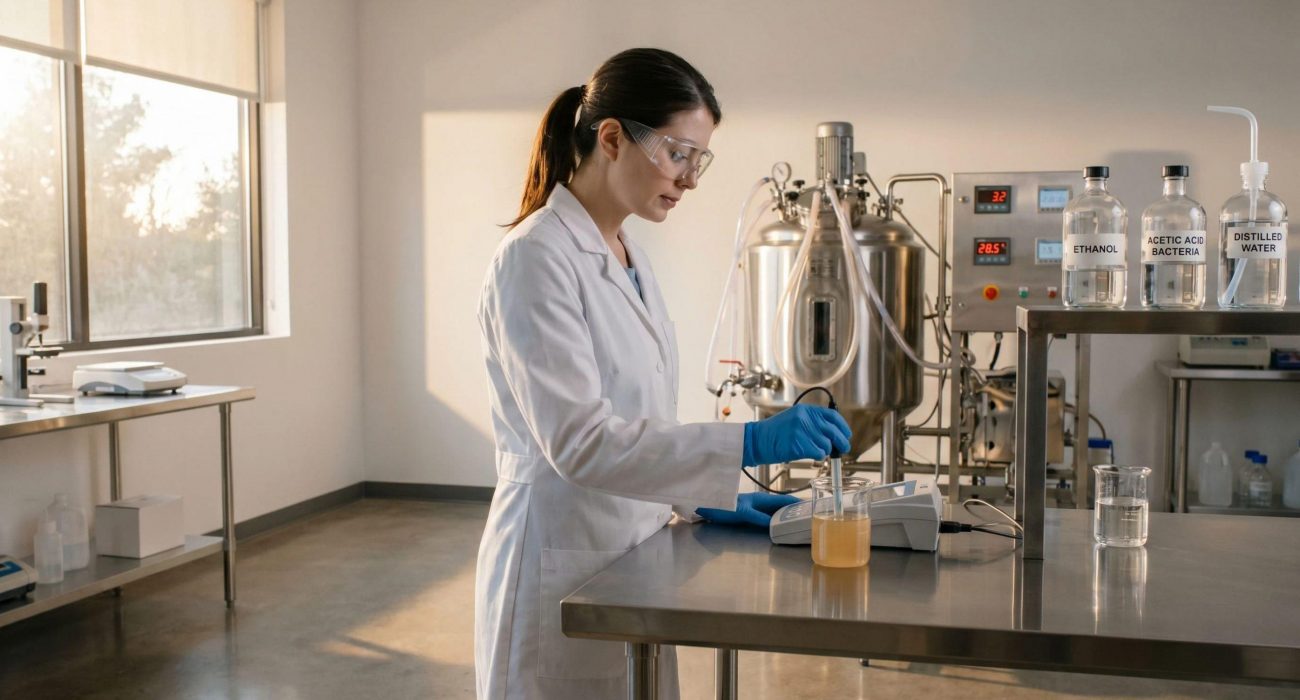
How Vinegar Is Produced | Acetic Fermentation and Industrial Production

Vinegar production in the food industry is based on a controlled biological process known as acetic fermentation, in which alcohol is converted into acetic acid through the action of specific bacteria.
This process makes it possible to obtain a stable, safe product suitable for a wide range of food and industrial applications. Understanding how vinegar is produced is essential to ensure the quality of the finished product, optimise production and achieve consistent results between batches.
What Is Acetic Fermentation?
Acetic fermentation is a process of biological oxidation in which bacteria of the genus Acetobacter convert ethanol into acetic acid in the presence of oxygen.
The process produces:
- Acetic acid, the main component of vinegar.
- Water.
- Secondary compounds that influence the final profile.
In industrial production, this process is not left to chance. It is controlled through technical parameters such as:
- Temperature.
- Oxygenation.
- pH.
- Alcohol concentration.
Controlling these variables makes it possible to obtain vinegar with stable and reproducible characteristics.
Raw Materials Used in Vinegar Production
Several basic elements are required to produce vinegar:
- Base alcohol. Derived from wine, cider, cereals, beet or other fermented sources.
- Water. Used to adjust concentrations.
- Acetic acid bacteria. Responsible for converting ethanol.
- Oxygen. Essential for acetic fermentation.
The quality of these raw materials directly influences production efficiency and the final profile of the vinegar.
Industrial Vinegar Production: Modern Systems
In modern industrial production, efficiency, batch-to-batch consistency and technical control are key factors. For this reason, modern systems are based on automated processes designed to ensure consistent quality and high production capacity.
At Goyval Vinagres, we work with controlled fermentation systems in which essential parameters are monitored, including:
- Temperature.
- Oxygenation.
- pH.
- Alcohol concentration.
- Processing times.
This enables us to produce a consistent, stable vinegar adapted to the requirements of the food industry.
The main advantages include:
- Continuous production.
- Greater production efficiency.
- Batch-to-batch consistency.
- Continuous quality control.
- Capacity for large volumes.
Variables That Influence Acetic Fermentation in Industry
In addition to the basic process conditions, other factors directly influence production efficiency and the final quality of the vinegar.
The most relevant include:
- Initial alcohol concentration.
- Bacterial activity and stability.
- Aeration level.
- Foam control.
- Quality and purity of raw materials.
Correct management of these variables helps optimise production, improve product quality and ensure repeatable results between batches.
Key Conditions in Acetic Fermentation
To produce vinegar efficiently, different variables must be controlled throughout the process.
- Controlled temperature. It must remain within suitable ranges to support bacterial activity and avoid deviations.
- Presence of oxygen. Oxygen is essential for acetic acid bacteria to convert alcohol into acetic acid.
- Suitable pH. A controlled environment helps maintain process stability and final product quality.
- Initial alcohol concentration. This must be adjusted according to the type of vinegar and the production objective.
- Fermentation time. This varies depending on the system used and the required specifications.
Incorrect management of these factors can lead to reduced production efficiency, variations in acidity or quality issues.
Equipment Used in Vinegar Production
Modern vinegar production uses equipment designed to maximise control, safety and efficiency:
- Industrial fermenters. Used to control the entire process.
- Aeration systems. Ensure an adequate supply of oxygen.
- pH and temperature sensors. Provide continuous monitoring.
- Filtration systems. Remove impurities.
- Continuous process monitoring.
These systems make it possible to maintain stable and repeatable processes in large-volume production.
Quality Control in Vinegar Production
Quality control is essential throughout the production process.
It usually includes:
- Acidity measurement.
- Microbiological controls.
- Physicochemical parameters.
- Stability verification.
- Production traceability.
These controls help ensure compliance with current regulations and maintain food safety.
Applications of Industrially Produced Vinegar
Vinegar obtained through acetic fermentation is widely used across different areas of the food industry:
- Sauces and dressings.
- Marinades.
- Fish preserves.
- Pickles.
- Prepared foods.
- Specific industrial food applications.
Its functionality depends largely on the quality of the production process and the stability of the finished product.
Continuous Production and Industrial Capacity
One of the main challenges in the food industry is adapting acetic fermentation to continuous production systems that maintain efficiency without compromising the quality of the finished product.
Modern processes make it possible to:
- Reduce downtime.
- Maintain stable parameters over long periods.
- Increase production capacity without affecting quality.
- Improve operational efficiency through automation.
Process scalability is particularly important for manufacturers with constant demand, such as those producing sauces, marinades and preserves.
For this reason, the design of the fermentation system and control of operating conditions are essential to ensure a stable supply adapted to the requirements of the industry.
In Summary
Vinegar production is not simply a natural transformation, but a technical process that requires experience, control and precision.
At Goyval Vinagres, we work with controlled processes, carefully selected raw materials and industrial capacity to provide reliable solutions adapted to manufacturers, distributors and food industry professionals.
Contact our team to discuss the requirements of your project.