
'/%3E%3C/svg%3E)
'/%3E%3Cpath%20fill='%23b2b2b2'%20d='M241%20382q0%2016%2017%2026%2017%2011%2042%2011t42-11q16-11%2017-26V269H241'/%3E%3Cpath%20fill='%239f7e00'%20d='M241%20379q0%2014%208%2023%209%209%2021%209%2014%200%2021-9%209-9%209-23V269h-59'/%3E%3Cpath%20d='M241%20339v-70h59v110q0%2014-9%2023l-6%205v-68h-15v72q-8%200-14-4v-68zm59%2040c0%2022%2015%2032%2029%2032%2021%200%2030-18%2030-32v-40h-59'/%3E%3Cpath%20fill='%239f7e00'%20d='M266%20277v5h2v12h-3v-5h2v-5h-9v5h2v5h-4v9h3v18h-5v10h34v-10h-5v-18h3v-9h-4v-5h2v-5h-9v5h2v5h-3v-12h2v-5zm42%20101q0%2010%206%2017%206%206%2015%207%2010-1%2016-7%206-7%206-17v-29h-43'/%3E%3Ccircle%20fill='%230044ad'%20cx='329.5'%20cy='372'%20r='6'/%3E%3Cellipse%20fill='%230044ad'%20cx='300'%20cy='340'%20rx='16'%20ry='21'/%3E%3C/svg%3E)

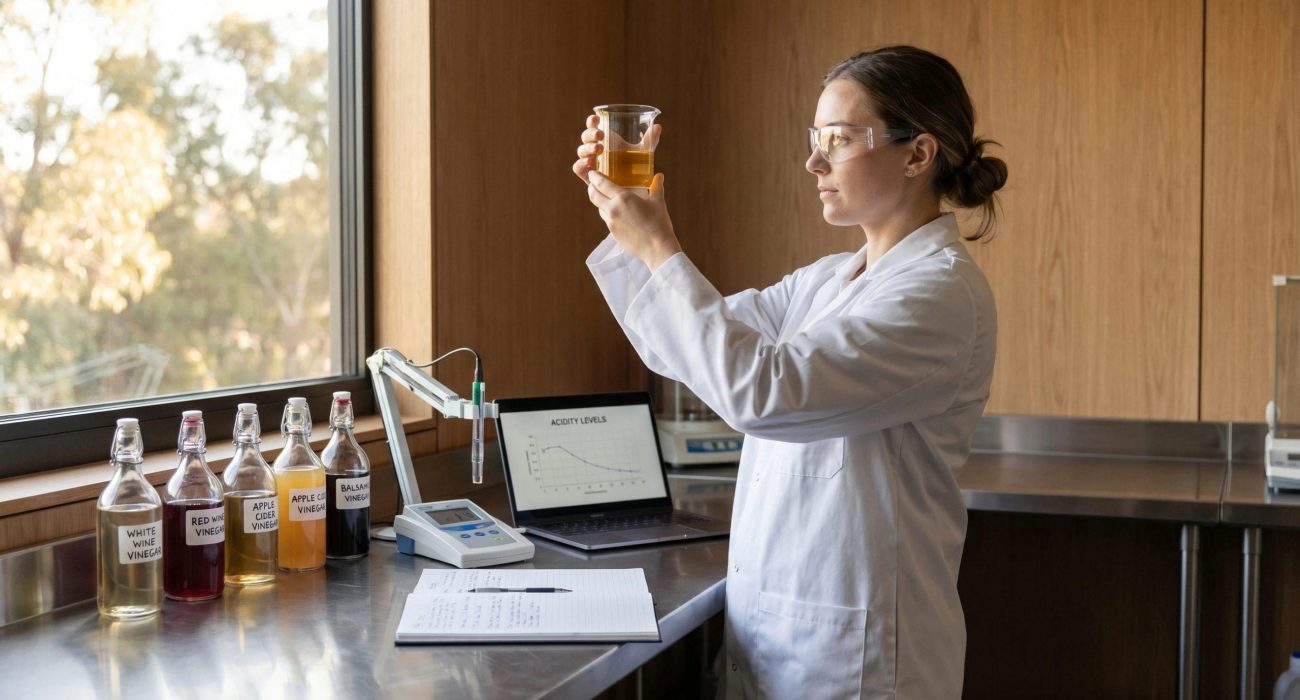
Vinegar for Sauces, Marinades and Preserves | How to Choose the Right One for the Food Industry

Vinegar is a key ingredient in the formulation of sauces, marinades and other food industry products. In addition to adding flavour, it directly influences product stability, pH control and microbiological safety.
In industrial environments, choosing the right vinegar for sauces and marinades is essential to achieve consistent results, maintain quality between batches and optimise production processes. The right choice does not depend only on the sensory profile; technical factors such as colour, acidity, stability, dosage and product behaviour during processing also play an important role.
Below, we look at the main types of vinegar used in sauces, marinades and preserves, their applications and the most important technical criteria to consider when selecting them.
Types of Vinegar for Sauces, Marinades and Preserves
In the food industry, not all vinegars perform the same function. The choice depends on the type of product, the desired sensory profile and the production process.
- Red wine vinegar. Widely used in full-flavoured sauces and meat or fish marinades thanks to its more robust character.
- White wine vinegar. Commonly used in sauces and dressings due to its clean, balanced profile. It provides acidity without overpowering other ingredients.
- Decolourised wine vinegar. Particularly useful in light-coloured sauces, mayonnaise, emulsions and formulations where acidity needs to be controlled without affecting the final colour of the product.
- Apple cider vinegar. Provides smooth, slightly sweet notes. Particularly suitable for poultry, vegetables and products with a lighter flavour profile.
- Balsamic vinegar. Ideal for added-value sauces, glazes and recipes requiring a more complex sweet-and-sour profile.
- Aged wine vinegar. Adds depth and character, particularly in more elaborate sauces and gourmet products.
- Spirit vinegar. A technical solution widely used in the food industry due to its neutrality, stability and precision in formulation. Ideal when functionality is required without interfering with the sensory profile.
In industrial applications, it is essential to work with vinegars that maintain consistent acidity and stable performance, particularly in large-scale production. Vinegar quality also depends on the acetic fermentation and industrial production process.
Applications of Vinegar in Sauces
The use of vinegar in sauces performs several technological functions within a formulation:
- pH regulation, which is fundamental to product safety.
- Flavour balance, helping to compensate for fat, sweetness or saltiness.
- Preservation, by helping to limit the development of microorganisms.
- Improved stability, particularly in packaged products.
- Enhancement of the organoleptic profile.
It is commonly used in:
- Cold sauces.
- Vinaigrettes.
- Ketchup and tomato sauces.
- Mustards.
- Mayonnaise and emulsions.
- Premium sauces and glazes.
In industrial production lines, even small variations can affect both flavour and shelf life, making batch-to-batch consistency particularly important.
Vinegars for Marinades: How to Choose the Right One
When used in marinades, the vinegar should be selected according to the food, production process and desired final result.
- More intense profiles are often used for red meats.
- Milder, more balanced options work well with poultry and fresh fish.
- In prepared foods, consistency and precise dosing are prioritised.
- Premium recipes may use vinegars with greater aromatic complexity.
In industrial production, it is also essential to ensure consistency, precise dosing and batch-to-batch uniformity, making the choice of vinegar even more important.
Applications in the Fish Preserving Industry
One sector where vinegar plays a particularly important role is the fish preserving and semi-preserving industry. In these products, the type of vinegar selected directly influences flavour, final appearance and product stability.
Common examples include:
- Anchovies in vinegar.
- Prepared or vinegared mussels.
- Marinated sardines.
- Mackerel and frigate tuna in escabeche.
- Prepared cockles and shellfish.
- Seasoned octopus.
- Escabeche preparations.
For example, decolourised white wine vinegar is often used for anchovies to provide acidity without altering the colour of the fish, while red wine vinegar may be used in other preparations where a more intense profile is required.
In these applications, acidity control and batch-to-batch consistency are essential.
Applications in the Pickling Industry
Vinegar is also an essential ingredient in the production of pickles and acidified vegetables, where it contributes to preservation, flavour and microbiological stability.
It is commonly used in:
- Gherkins.
- Pickled onions.
- Pickled carrots.
- Cauliflower.
- Mixed pickled vegetables.
- Vegetable mixes.
- Jalapeños and international products.
- Other acid-preserved vegetables.
This sector generally requires vinegars with consistent acidity, a clean profile and stable performance in large production volumes.
Common Problems When Using Vinegar Industrially and How to Avoid Them
In industrial processes, using an unsuitable or inconsistent vinegar can lead to issues that affect both final product quality and production efficiency.
Some of the most common include:
- Variations in acidity between batches.
- Changes in flavour profile.
- Unwanted colour changes.
- Lack of stability in the finished product.
- Excessive acidity that unbalances the formulation.
- Difficulties with dosing on the production line.
- Inconsistent results between production runs.
To avoid these problems, it is essential to work with vinegars that meet clear technical specifications and to maintain strict control over dosing and processing.
What Should an Industrial Vinegar Supplier Offer?
Beyond the product itself, a specialised supplier should be able to guarantee:
- Stable acidity.
- Consistent quality.
- Traceability.
- Food safety.
- Supply capacity.
- Flexible formats.
- Adaptation to technical requirements.
Working with a reliable industrial vinegar supplier helps reduce issues and improve production efficiency.
Supply Formats for the Food Industry
Vinegar for food manufacturers can be supplied in different formats according to each customer’s volume and operational requirements:
- Bulk.
- IBCs.
Choosing the right format facilitates storage, handling and integration into the production process.
Innovation and New Trends
The development of new products within the food industry is also driving demand for more distinctive vinegar solutions:
- Fruit vinegars.
- Infused vinegars.
- International flavour profiles.
- Premium sauces made with speciality vinegars.
- New pickles and gourmet recipes.
These trends make it possible to create higher added-value products without compromising technical functionality.
In Summary
Vinegar is a key raw material in sectors such as sauces, marinades, fish preserves, pickles and prepared foods. Choosing the right type of vinegar directly influences finished product quality, stability and market acceptance.
At Goyval Vinagres, we work with manufacturers, distributors and food industry professionals, providing solutions adapted to each industrial application, with reliable supply and consistent technical specifications.
If you need a vinegar adapted to your production process, contact our team and we will assess the most suitable option for your requirements.