
'/%3E%3C/svg%3E)
'/%3E%3Cpath%20fill='%23b2b2b2'%20d='M241%20382q0%2016%2017%2026%2017%2011%2042%2011t42-11q16-11%2017-26V269H241'/%3E%3Cpath%20fill='%239f7e00'%20d='M241%20379q0%2014%208%2023%209%209%2021%209%2014%200%2021-9%209-9%209-23V269h-59'/%3E%3Cpath%20d='M241%20339v-70h59v110q0%2014-9%2023l-6%205v-68h-15v72q-8%200-14-4v-68zm59%2040c0%2022%2015%2032%2029%2032%2021%200%2030-18%2030-32v-40h-59'/%3E%3Cpath%20fill='%239f7e00'%20d='M266%20277v5h2v12h-3v-5h2v-5h-9v5h2v5h-4v9h3v18h-5v10h34v-10h-5v-18h3v-9h-4v-5h2v-5h-9v5h2v5h-3v-12h2v-5zm42%20101q0%2010%206%2017%206%206%2015%207%2010-1%2016-7%206-7%206-17v-29h-43'/%3E%3Ccircle%20fill='%230044ad'%20cx='329.5'%20cy='372'%20r='6'/%3E%3Cellipse%20fill='%230044ad'%20cx='300'%20cy='340'%20rx='16'%20ry='21'/%3E%3C/svg%3E)

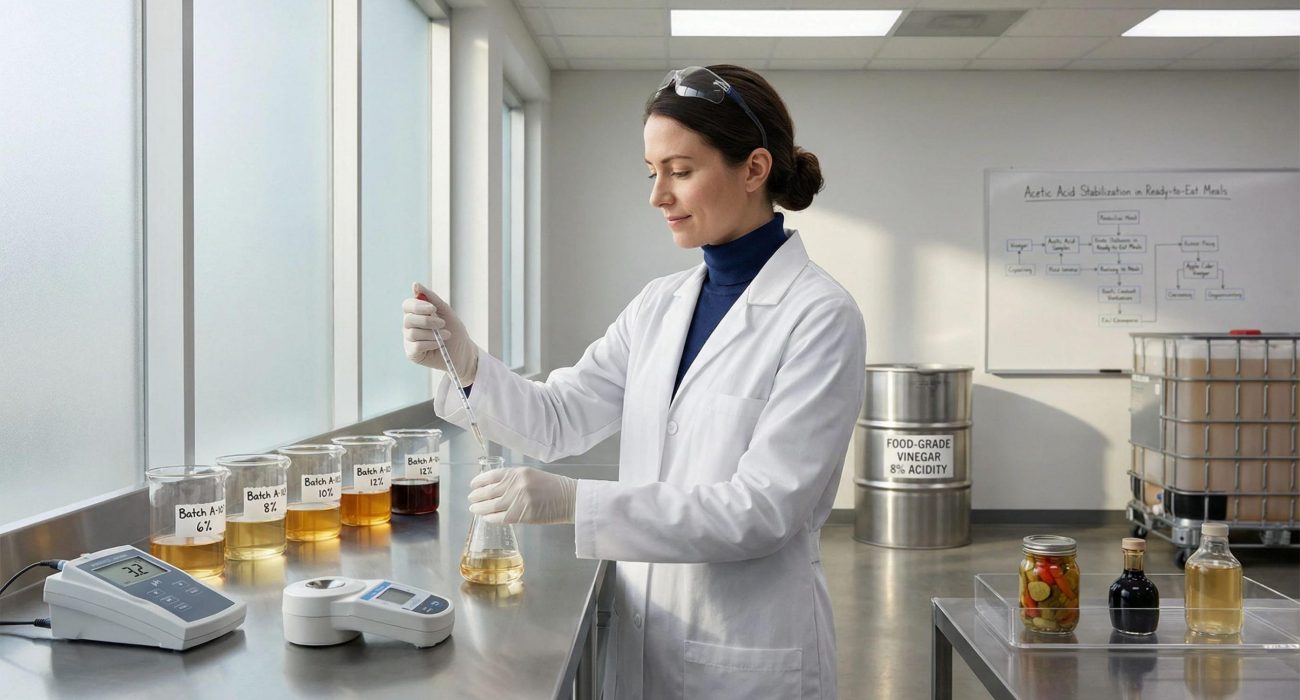
Uses of Vinegar in the Food Industry | Real Applications, Benefits and How to Choose the Right One

Vinegar is a key ingredient in the food industry, used both for its preservative properties and for its ability to regulate pH and improve the sensory profile of foods.
However, its role goes far beyond that of a simple acidifier. In industrial environments, vinegar directly influences food safety, product stability and consistency throughout production processes.
Understanding the uses of vinegar in the food industry and choosing the right type of vinegar for each application is essential to achieve the best results.
What Is Vinegar Used for in the Food Industry?
Vinegar is mainly used in the food industry as:
- A natural preservative.
- An acidity regulator (pH).
- A flavour enhancer.
- A stabilising ingredient in formulations.
Thanks to its acetic acid content, it can contribute to controlling the growth of certain microorganisms and to product stability, depending on the formulation and production process used.
It is commonly used in pickles, sauces, preserves, meat products and ready-to-eat foods.
Main Applications of Vinegar in the Food Industry
Food Preservation
Vinegar acts as a preservative by creating an acidic environment that makes it more difficult for bacteria, yeasts and moulds to develop.
It is widely used in:
- Pickles.
- Vegetable preserves.
- Sauces and dressings.
- Prepared foods.
In industrial applications, different acidity levels are used depending on the application, formulation and technical requirements of the finished product.
Batch-to-batch consistency is a critical factor in these applications, as even small variations can affect the final result.
pH Regulation in Foods
pH control is one of the most important aspects of food production.
Vinegar can be used to:
- Adjust acidity levels in formulations.
- Help achieve suitable conditions for thermal processing.
- Improve stability throughout shelf life.
Working with controlled and repeatable parameters is essential to maintain product quality in large-scale production.
Production of Pickles and Preserves
Pickles are one of the most representative uses of vinegar in the food industry.
In these products, vinegar:
- Provides the necessary acidic environment.
- Contributes to the microbiological control of the product.
- Defines a significant part of the final flavour.
For these applications, it is essential to use vinegars with consistent acidity and stable performance, particularly in continuous production.
Sauces, Vinaigrettes and Dressings
In sauces and dressings, vinegar not only contributes to preservation, but also helps build the flavour profile.
Its main functions include:
- Balancing fatty or sweet notes.
- Adding freshness.
- Enhancing other ingredients.
- Contributing to product stability.
The type of vinegar used directly influences the finished product, making it an important decision during product development.
Meat Products and Marinades
In the meat industry, vinegar is used in marinades and certain formulations for its ability to:
- Adjust pH.
- Contribute to preservation.
- Support food safety.
- Influence texture and flavour.
Precise dosing is important to avoid unwanted effects on the finished product.
Prepared Vegetables and Ready-to-Eat Products
In processed vegetable products and ready-to-eat foods, vinegar can help to:
- Maintain stability during distribution.
- Reduce the risk of microbiological alterations.
- Ensure consistency in production.
Its integration into automated production lines facilitates large-scale manufacturing.
Types of Vinegar Used in the Food Industry
Not all vinegars perform the same function. The choice depends on the type of product, the process and the desired market positioning.
The most commonly used include:
- Spirit vinegar: a neutral profile, ideal for technical applications and pickling.
- Wine vinegar: provides greater sensory complexity.
- Apple cider vinegar: milder and suitable for more delicate products.
- Balsamic vinegar: used in sauces and premium products.
- Organic vinegar: increasingly in demand in retail and export markets.
Choosing the right type of vinegar affects both production performance and the way the finished product is perceived.
Common Problems When Using Vinegar and How to Avoid Them
In industrial environments, problems can arise from choosing or managing vinegar incorrectly:
- Variations in acidity between batches.
- Changes in sensory profile.
- Microbiological stability issues.
- Vinegars that are too aggressive for the formulation.
- Lack of consistency in production.
These problems are often related to product quality or a lack of clear specifications rather than to the production process itself.
Formats and Supply for Industry
Vinegar for the food industry can be supplied in different formats according to the requirements of each facility:
- Bulk.
- IBCs.
- Palletised containers.
The choice depends on production volume, dosing systems and internal logistics.
A reliable and appropriately adapted supply is essential for maintaining operational continuity.
The Importance of the Technical Data Sheet
The vinegar technical data sheet is an essential document in the food industry.
It includes information such as:
- Acetic acid concentration.
- Physicochemical parameters.
- Storage conditions.
- Regulatory compliance.
Working with clear specifications helps ensure traceability, quality and suitability for each production process.
Frequently Asked Questions About the Use of Vinegar in the Food Industry
What acidity should vinegar have for use in the food industry?
It depends on the application, formulation and technical requirements of the finished product. The appropriate acidity level should be defined according to the intended use.
What type of vinegar is used in industrial pickling?
Spirit vinegar is commonly used because of its neutral profile and stability.
Can vinegar replace artificial preservatives?
In certain formulations, vinegar can form part of the product’s preservation strategy, although its effectiveness will depend on factors such as pH, formulation, processing and storage conditions.
What is the difference between spirit vinegar and wine vinegar in industrial applications?
Spirit vinegar has a more neutral and technical profile, while wine vinegar provides greater sensory complexity.
Do You Need Advice for Your Production Process?
Understanding the uses of vinegar in the food industry is essential. Its ability to contribute to preservation, stability and the sensory profile of foods makes it an important ingredient in many industrial applications.
Choosing and using the right vinegar can help optimise production processes, support food safety and maintain quality in large-scale manufacturing.
If you are developing a new product, adjusting a formulation or looking for a reliable supply adapted to industrial production, choosing the right vinegar can make a real difference. At Goyval Vinagres, we work with manufacturers and adapt each solution to the technical requirements of every customer.
If you need a vinegar adapted to your production process, contact our team and we will assess the most suitable option for your requirements.